
About Food Truck ROI

Food Truck ROI creates practical digital tools for food truck operators and mobile caterers who need a better way to quote private events, track booking inquiries, and decide whether an event is worth the time, fee, and crew.

Launch list open, no monthly software planned Excel workbook plus browser tools Built for quotes, bookings, and event review Local/offline-first tool files Clear support and refund pages

Most event decisions start with incomplete information.

A private event request can look simple at first: a guest count, a date, a location, and a few menu questions. Then the real work starts. Is the host paying, or are guests paying at the truck? Does the event need a minimum guarantee? Is there a deposit? How many hours will the crew be tied up after prep, load-in, service, cleanup, and travel?

Public events bring a different problem. A festival, brewery night, school fundraiser, apartment complex, or market can come with a booth fee, uncertain attendance, competing food vendors, power rules, weather exposure, and no clean way to know whether the truck is likely to make enough money.

Food Truck ROI was built around that gap. We kept coming back to the same practical need: operators need a way to check the numbers, keep the booking details straight, and learn from past events without paying for a full monthly platform that does more than they need.

Tools for the work around each event.

The Food Truck Event Profit Toolkit includes one Excel workbook and two browser-based tools. Each one is built for a specific job that comes up before, during, or after an event.

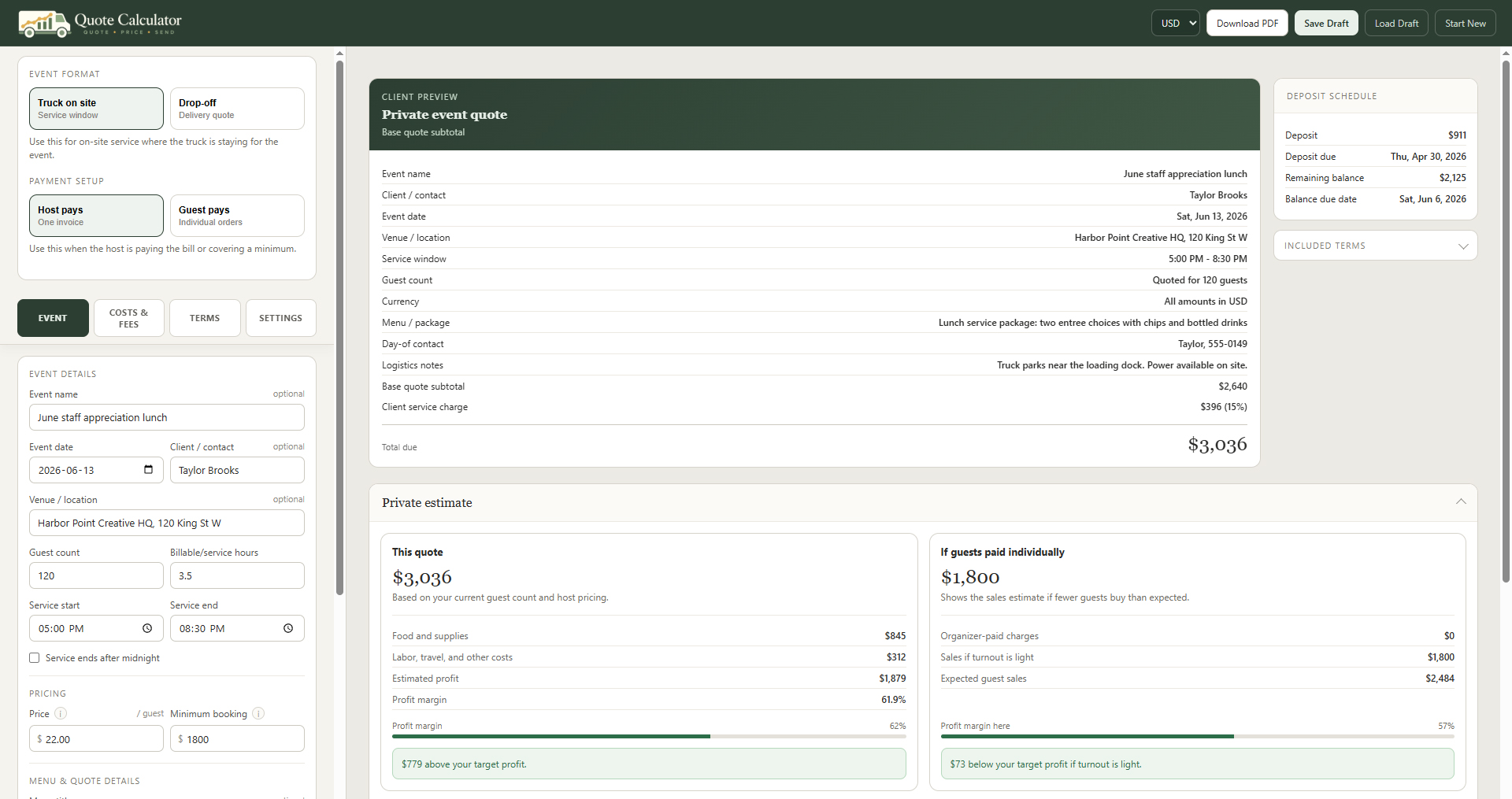
Catering and private event quote calculator preview
Tool 01 Included

Catering / Private Event Quote Calculator

Use it when a host asks for a private party, corporate lunch, wedding snack, or drop-off quote and you need a cleaner way to account for food, packaging, crew, travel, service time, deposit, and minimum terms.
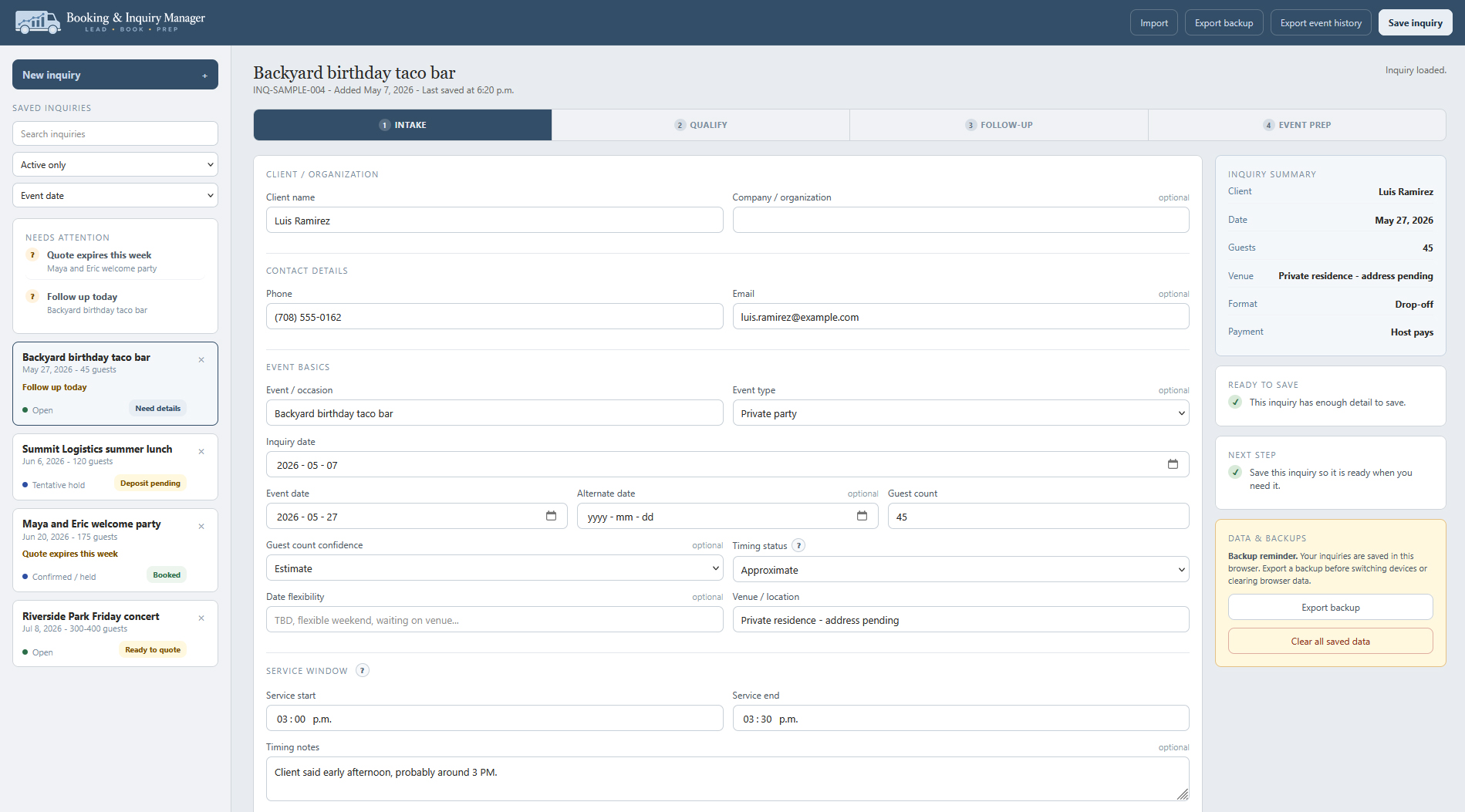
Booking and inquiry manager preview
Tool 02 Included

Booking & Inquiry Manager

Use it to keep inquiries from living in texts, email threads, and memory. Track status, follow-up, deposit, final count, parking, power, prep notes, and the details that matter before service.

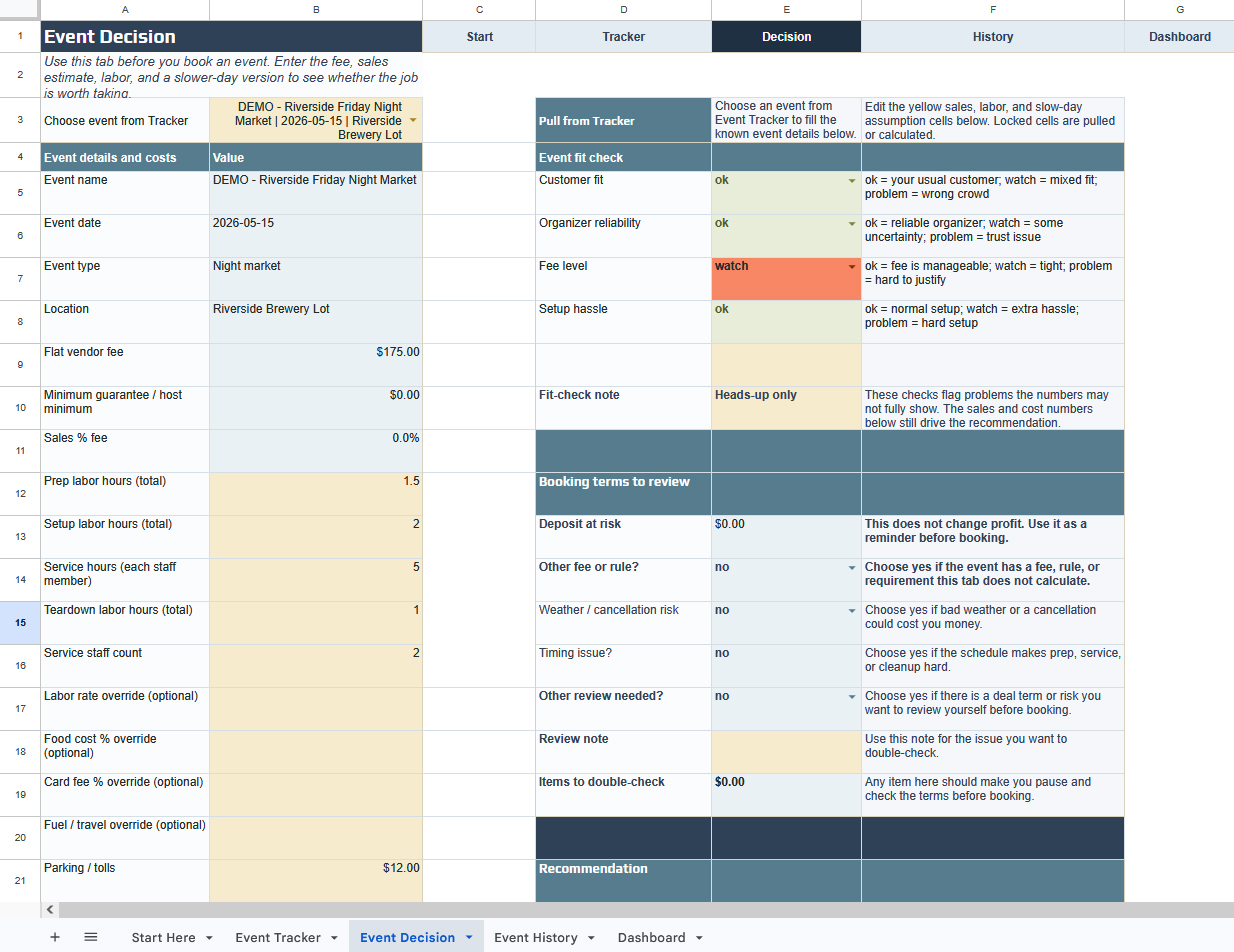
Food Truck Event ROI Workbook preview
Tool 03 Included

Event ROI Workbook

Use it before or after an event to compare vendor fees, expected sales, downside risk, labor, food cost, travel, and what actually happened once the truck was back.

Quote the job. Track the booking. Review the result.

The tools are meant to work in the same order many operators already think through an event: check whether the job is worth pricing, build the quote, keep the details organized, then compare the result after service.

Step 01

Check the minimum

Use the free calculator or quote tool to make sure the event has enough room for food, crew, travel, setup, and margin.

Step 02

Confirm the booking

Track follow-up, deposit, final count, menu, service window, parking, power, and prep notes before the event gets close.

Step 03

Review what happened

Compare estimate against actual sales, costs, labor, travel, vendor fee, weather, and whether you would take that kind of job again.

Built by looking closely at the work operators already do.

Food Truck ROI is not trying to sound like a giant software company. The product is built from a more practical place: food truck operators need help with repeatable event decisions, and the tools should stay close to that work.

The pages and tools are shaped around real operator questions: What should the minimum be? How should a guest-paid guarantee work? What does a vendor fee need to produce before it makes sense? What should be tracked before the event? What did the truck actually make after food cost, labor, travel, and fees?

That is also why the toolkit is narrow. It does not try to run your entire business. It focuses on the parts of event work that often get handled through rough spreadsheets, phone notes, inbox threads, and memory.

How our guides are built.

The guides start with the work food truck operators already have to do: price the job, check the service window, ask for the right booking details, protect the truck from weak guest-paid turnout, and review whether an event was worth the date.

Public examples are used as benchmarks, not as universal rules. A vendor fee, minimum guarantee, service window, or pricing model can make sense in one market and fail in another because the menu, crew, local rules, date, traffic, and event setup are different.

That is why the site avoids fake national averages and one-size-fits-all answers. Local rules can vary by city, county, venue, event type, and equipment setup, so the guides are written to help operators ask better questions and make cleaner decisions before they commit the truck.

Built around the details that change whether an event is worth taking.

Private events

Host-paid and guest-paid pricing need different checks.

Private parties, corporate lunches, weddings, and drop-off jobs need clear minimums, deposit terms, final counts, travel, setup, and service-window assumptions.

Vendor events

A fee is only one part of the event math.

Vendor fees, sales history, weather risk, power, parking, vendor count, menu overlap, and load-in rules all affect whether a public event makes sense.

Booking details

The follow-up work needs a home.

Deposit status, point of contact, prep notes, final count, power needs, parking, service time, and event-day reminders are easier to manage when they are not scattered.

Local files

The bundle is built for local use, with backups.

The workbook is an .xlsx file with no macros. The browser tools are local/offline-first, and operators should export or back up working data regularly.

Better event decisions come from clearer numbers and cleaner follow-up.

A busy event is not always a good event.

Long service windows, weak placement, extra crew, power rules, and a high vendor fee can erase the sales number that looked good at first.

A quote should protect the truck, not just cover the food.

Food cost matters, but so do prep, packaging, load-in, travel, setup, cleanup, admin time, deposits, and the other work behind the menu price.

Simple tools get used during a busy week.

The bundle is intentionally focused. It is meant to help with event quotes, booking notes, and event review without becoming another system to manage.

The follow-up matters as much as the first number.

A decent quote can still fall apart when the final count, deposit, service window, parking, power, or point of contact never gets confirmed.

What the toolkit is, and what it is not.

Food Truck ROI is not a POS system, accounting platform, online ordering system, contract system, route planner, or full CRM. It is a focused set of downloadable tools for quoting events, tracking inquiries, and reviewing event profitability.

The product is best for operators who want more structure than a blank spreadsheet, but do not want to commit to another monthly login just to handle private events, guest-paid minimums, booking notes, and vendor fee decisions.

See the tools built for the quote, the booking, and the event review.

If you want a more organized way to price private events, keep inquiry details straight, and compare event profit after the truck gets back, review what is included in the Food Truck Event Profit Toolkit.